

 Login
Login
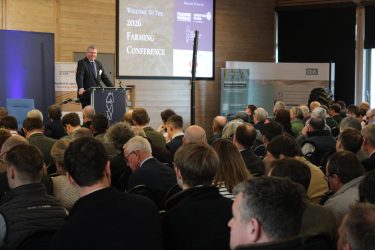
Last month, we were delighted to co-host the annual Farming Conference alongside Fram Farmers and the Suffolk Agricultural Association, welcoming more than 300 attendees from across the agriculture and rural sector to Trinity Park.
With over 80 farmers giving up a valuable day on their farms to attend, the strength of engagement alone underlined just how important events like this have become. In a sector where volatility is now the norm rather than the exception, the appetite for practical advice, fresh thinking and collaborative solutions has never been stronger.
Our 2026 programme was designed to reflect that reality. Taking delegates on a virtual farm walk, the day explored the key areas of on-farm decision-making through the lenses of innovation, resilience and profitability – focusing firmly on what farmers can do now to future-proof their businesses.
A sector full of opportunity
We were thrilled to welcome Dr. David Hughes, Professor of Food Marketing as our headline speaker, alongside a wide range of respected industry voices. With the generous support of headline sponsors HSBC, the conference tackled some of the biggest forces reshaping UK agriculture – from climate change and geopolitics to consumer behaviour, technology and finance.
Professor Hughes set the scene with a fascinating overview of UK and global food trends, changing buying habits and the growing importance of how food is marketed and positioned. Sharing a message that resonated strongly throughout the day: diversification is becoming essential to scaling profitability in a more uncertain world.
That theme was reinforced by Tim Lang, who delivered a hard-hitting assessment of the risks facing food production and distribution – risks that go far beyond climate change alone. Yet his message was not one of pessimism. Instead, he highlighted the opportunities to rethink operating models, strengthen local food systems and develop shorter supply chains that better serve regional markets. Central to this, he argued, is the need to invest in socio-economic food infrastructure and collaboration.
Innovation, science and new value streams
The role of science and innovation in creating practical solutions was another major focus of the conference. Insights from genetic research demonstrated how advances in crop development can open up new markets, improve resilience and increase value.
There’s also growing interest in the idea of food as healthcare, and how diversification into new crops and products could align commercial opportunity with wider societal benefits. Once again, the message was clear: starting to diversify early gives businesses more control and options later on.
Natural capital emerged as a particularly important opportunity area. Speakers including Robert Shepherd of the Environmental Farmers Group and Ryan Clark, an ecologist at Brown & Co, explored how biodiversity net gain and cooperative approaches can provide additional income streams while supporting long-term land stewardship.
Collaboration was a recurring theme. Whether through farming groups, co-operatives or clusters, the benefits of working together – to share knowledge, reduce risk and access opportunities that might otherwise be out of reach – were consistently highlighted.
John Pawsey’s insights into farm clusters brought this to life, showing how shared vision, respected leadership and voluntary participation can drive real results, with little downside, following the ongoing success of Suffolk’s Wool Towns Cluster
Renewables, energy and informed decision-making
Renewable energy also featured prominently, with Jamie Banks of New Stream Renewables discussions covering how income models such as power purchase agreements can successfully support farming businesses.
But whilst the potential returns are attractive and align strongly with the net zero agenda, speakers were clear about the importance of understanding the legal, tax and commercial implications.
Callum Ross of Mills & Reeve provided valuable guidance on how to protect landowner interests when developers approach, emphasising the need for robust legal structures that safeguard the wider farming operation.
This was echoed in a session by our own Farming and Estates Partner Jack Deal who explored the tax implications of traditional farming compared to renewables and other diversified activities. Highlighting how long-term commitments require flexibility, and that tax efficiency should never be pursued in isolation from wider business objectives. The key message: renewables can be an excellent diversification route – but only when entered into with eyes open and the right advice in place.
Collaboration, integration and controlling volatility
Looking beyond energy and environment, the conference also examined vertical integration, machinery sharing and labour collaboration as practical ways to improve profitability and resilience.
Sessions on vertical integration began with Barney Kay of Noble Foods sharing how adding value through closer control of production stages – often in collaboration with neighbouring farms – can reduce volatility and improve margins, while also acknowledging the cultural challenges around change and perceived loss of independence.
Andrew Fairs of HJ Fairs & Son explained that their long-term work in combinable crops, including alternative and high-value crops such as borage, illustrated how controlling more of the value chain can enhance efficiency and stability. Communication, he noted, is critical – and requires investment.
Josiah Meldrum, co-founder of Hodmedod’s offered an inspiring perspective on building niche, high-value food businesses by learning from global techniques, creating strong marketing stories and developing open supply networks enabling them to step away from highly volatile commodity markets.
Practical examples of machinery and labour sharing followed with Douglas Inglis, Damien Delattre and Ian Matts offering insights from experience, that included Damien’s perspective from a French farming cooperative model. All demonstrated how collaboration can significantly reduce costs when supported by the right structures and clear agreements, along with showcasing the considerations and mindset adjustments for those farmers considering such options.
Confidence in the future
The conference closed on a note of cautious but genuine optimism. Martin Hanson of HSBC spoke about the importance of commercially viable planning in a world where government support is reduced and increasingly uncertain.
He highlighted a noticeable shift within the industry – away from focusing on what has been lost, and towards asking “what are we going to do about it?”
And how, that mindset, combined with innovation, collaboration and sound commercial planning, gives real cause for confidence.
HSBC’s commitment to put an additional £1bn of lending into UK farming over the coming years sent a powerful signal of belief in the sector’s future. As Martin noted, financiers must get behind innovation, natural capital markets, carbon markets and renewables – and that support is already building momentum.
Feedback from attendees reinforced what we felt throughout the day: that this was a valuable event at a critical time for the sector.
As one delegate commented:
“The speakers were of top quality and the subjects chosen very relevant for these difficult times. The dovetailing of the topics and close control of the timetable led to a very focused programme which the audience very much appreciated.”
So, what’s next?
The challenges facing agriculture are real – but so are the opportunities. The conference made one thing abundantly clear: businesses that take time to review their position, explore options, collaborate together and make informed decisions will be far better placed to thrive in the years ahead.
We’re proud to have played a part in bringing together so many ideas, insights and voices, and we look forward to continuing the conversation with farmers and rural businesses as they navigate what comes next.
Our next Farming Conference will be held online in early 2027. To be one of the first to hear when tickets become available, and for regular agricultural financial updates, please contact rachel.turnbull@scruttonbland.co.uk to be added to our mailing list.







 Back
Back